The contradiction is increasingly visible. Telecommunications operators and public authorities are investing heavily in fiber deployment to meet the demands of cloud services, remote work, AI infrastructure and data-intensive lifestyles. At the same time, this expansion generates a growing stock of obsolete or damaged cables whose composite structure makes end-of-life treatment far more complex than that of conventional metals.
Unlike simple mono-material waste streams, fiber-optic cables are engineered for resistance, insulation and tensile performance. Those qualities are invaluable during installation and network use, but they complicate dismantling and material recovery. The industrial question is no longer merely whether these cables can be collected; it is whether each fraction can be separated cleanly enough to retain value.
Inside the Cable: Three Technical Layers
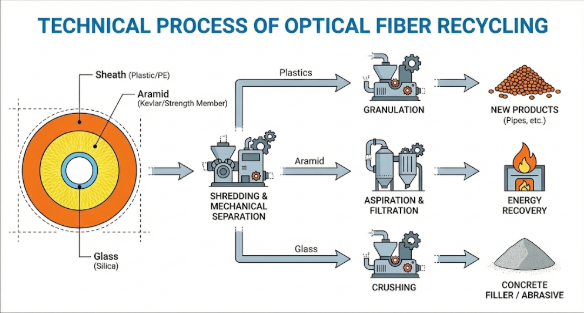
Although cable designs vary depending on telecom applications, the structure presented in the recycling schema reflects a typical logic built around three major components:
- PE Sheath (Polyethylene): the external protective layer, generally made of polymeric materials such as polyethylene, designed to resist moisture, abrasion and outdoor exposure.
- Aramid / Kevlar reinforcement: a high-performance synthetic fiber used as a strength member, providing tensile resistance during installation and limiting mechanical stress on the optical core.
- Silica glass core: the central glass-based optical element, made primarily of high-purity silica, through which light signals are transmitted.
From a recycling standpoint, each of these materials belongs to a different technical family. Polymers require reprocessing through granulation or compounding. Aramid fibers demand careful extraction because of their light weight and fibrous nature. Silica-rich glass must be crushed and conditioned before it can be reintroduced into industrial uses such as fillers or abrasive media.
The Industrial Process, Step by Step
1. Shredding and Mechanical Separation
The first stage is a controlled size-reduction process. Decommissioned cables are fed into shredding equipment that breaks them into smaller fragments while preserving the possibility of downstream sorting. This is followed by mechanical separation techniques that distinguish the main material families according to density, shape, particle behavior and air-flow response.
- Shredding increases the exposed surface area of the cable fractions.
- Mechanical sorting isolates plastics, aramid reinforcement and glass-containing fractions.
- The objective is to limit contamination between streams, since purity directly affects reuse value.
2. Plastic Granulation for Secondary Products
Once separated, the polymer sheath fraction is directed toward granulation. In industrial terms, granulation transforms plastic fragments into a more uniform particulate feedstock that can be incorporated into secondary manufacturing chains.
- Recovered polyethylene-based polymers are cleaned and resized.
- The granulated material can be used in downstream molded or extruded products.
- End markets may include pipes, plastic components or other non-food industrial applications.
This step is crucial because raw shredded polymer has limited commercial utility. Granulation restores handling consistency and makes the material compatible with standard industrial processing equipment.
3. Aspiration and Filtration of Aramid Fibers
Aramid, often referred to through commercial names such as Kevlar, presents a different challenge. It is a lightweight, strong and fibrous material that can disperse easily if not managed within enclosed systems. Industrial aspiration and filtration units are therefore used to capture and isolate these fibers after mechanical separation.
- Air-based extraction systems recover fibrous aramid fractions.
- Filtration limits particulate loss and improves operator safety.
- Depending on quality, the recovered fraction may be valorized materially or routed toward energy recovery.
In practice, aramid recovery remains one of the more delicate steps in the chain. The economic outcome depends on contamination levels, local outlets and whether the material can be reused in technical compounds or must be treated as a fuel substitute.
4. Glass Crushing for Construction Uses
The silica-based glass fraction is generally sent to crushing equipment. Once reduced to an appropriate particle size, it can serve as a mineral input for construction and industrial applications.
- Crushed glass can function as a filler in construction materials.
- It may also be incorporated into concrete-related applications, depending on local specifications.
- In some processing chains, it can be used as an abrasive or mineral additive.
This outlet matters because glass from fiber-optic cables is not typically remelted back into telecom-grade optical material. Instead, its value lies in cascade use: redirecting the mineral fraction into sectors such as building materials, where particle performance can still be exploited.
Why It Matters for the Telecom Industry
The recycling of fiber-optic cables illustrates a wider industrial reality. The digital economy may appear immaterial to end users, but it rests on a massive physical substrate: conduits, servers, antennas, cable reels, connectors and maintenance waste. As networks expand, so too does the responsibility to manage the materials embedded in that infrastructure.
For telecom operators, recyclers and regulators, the circular-economy challenge is therefore twofold:
- Technical: building separation processes capable of recovering mixed materials without excessive contamination.
- Economic: securing stable outlets for recovered polymers, aramid fractions and crushed siliceous glass.
The strategic stakes go beyond waste management. A mature recycling chain can reduce dependence on virgin raw materials, lower disposal volumes and reinforce the environmental credibility of digital infrastructure projects. In a sector that markets itself as future-facing, the end of life of the cable may become just as important as the bandwidth it once carried.